
Daniel Widmer, the feeding devices specialist at Three-Tec, answers the most important questions about feeding.
Which industries typically use Three-Tec feeding devices, and what are these customers' requirements?
In addition to custom solutions and modifications, the advantages of our feeding devices include above-average quality, ease of cleaning, high-quality materials, durable drives, and effective seals; upon request, the devices are available with all types of certifications, including explosion-proof versions with ATEX certification. Our equipment is frequently used in the chemical, food, and pharmaceutical industries, but is essentially applicable in nearly all sectors. They can be used to feed any type of solid material. Although specifically designed for free-flowing and micronized powders, we can also feed semolina, grains, microgranules, pellets, flakes, shavings, and even fibers.
What material properties determine the selection of the appropriate feeding device?
This is one of the most important considerations, because it significantly affects the price of a feeder. The type of feeder is selected based on the flowability and type of bulk material. Single-screw feeders without a discharge aid or bridge breaker work well with free-flowing bulk materials. Single-screw feeders with a discharge aid work well with free-flowing to slightly bridging bulk materials. At Three-Tec, twin-screw feeders always have a discharge aid and are used for poorly flowing bulk materials that are more prone to bridging. These are often powdered materials.
What challenges arise when feeding poorly flowing bulk materials?
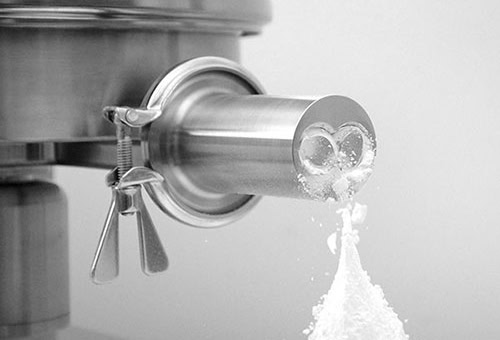
Bulk materials with poor or very poor flowability are often ‘cohesive’ (adhesive). The finer a powder is, the more cohesive it is. This leads to bridging in the feeding hopper that is so problematic that even discharge aids are insufficient and cause unstable discharge. To ensure uniform feeding of these powders, Three-Tec has developed the flat-tray feeding device. It is a twin-screw feeding unit featuring a cylindrical or negatively conical hopper that extends all the way down to the feeding screws. This shape and design prevents bridging issues and also helps ensure that even very light powders — such as those that are expanded, hollow, porous, or amorphous — are fed into the feeding screw evenly and quickly.
What is the difference between volumetric and gravimetric feeding systems, and when is each technology used?
Volumetric feeding devices are typically used in applications where accuracy requirements are not high, as they are more cost-effective than gravimetric systems. Gravimetric feeding systems are used wherever process traceability and/or high accuracy are required. Additional components — such as a platform scale and a differential feeding controller — must be added to a volumetric feeding system so that it can operate on a gravimetric basis. Volumetric feeding systems operate at constant speeds and cannot regulate automatically. In gravimetric feeding systems, the discharge rate is continuously measured and regulated by the PLC to maintain a specified throughput rate consistently and continuously. Factors such as container fill level, differences in bulk density, or uneven flow behavior are corrected by adjusting the screw speed. The load cell, which measures the differential weight, is exposed to all kinds of potential disturbances — such as vibrations, drafts, or temperature fluctuations — which the control system detects and filters out.
Why is precise feeding so important in industrial applications?
Feeding devices are not only needed for single-batch filling. When multiple feeding devices are required to create mixtures and formulations — for example, for downstream processing equipment such as mixers or extruders — this affects the quality of the final product. Consistent feeding makes processes safer and ensures that end products are more uniform.
How is it possible to dispense even very small quantities precisely and consistently?
Feeding small quantities or low throughput — whether in batches, lots, or continuously — is only possible with high-precision load cells and feeding devices designed for this purpose. These load cells must be digital. It is not sufficient to simply use digital strain gauge technology. Specialized and optimized weighing measurement methods must be employed, such as those used by Mettler-Toledo in its high-precision digital weighing modules. Only these systems provide the necessary data to ensure that the feeding process is controlled correctly. Given the small quantities involved, ‘small’ feeding devices are also required. Three-Tec offers a range of specially designed small twin-screw feeding devices with screw diameters of just 5 and 9 mm.
ATEX requirements play an important role in many industrial applications. What specific challenges do these requirements pose for the design and operation of feeding equipment?
Wherever hazards may arise during operation, the end user or end operator is responsible for implementing the necessary safety measures and ensuring safe operation. However, “safe” does not simply mean that the device is CE-compliant. If flammable dusts or gases may be present or generated in the device or its surroundings, explosion protection must be observed (Directives 2014/34/EU and 1999/92/EC). This can very often be the case with powder feeding, depending on the material. The end user must determine and specify the ATEX zone for their system and local conditions. As a machine manufacturer, Three-Tec can provide recommendations in advance and then implement these specifications. This is a highly complex topic that requires training and specialized knowledge. Special drives must be used, and depending on the ATEX zone, an additional approval by an independent, notified body may even be required.
Is there a particularly exciting customer project or a challenging feeding task that has stuck with you?
The beauty of process engineering is that you’re constantly faced with new challenges. Problems must be solved where others have no solutions or where the proposed solution hasn’t worked well enough. It therefore takes a great deal of experience and knowledge to be able to help customers in precisely these situations. There are many interesting projects. Special projects, for example, involve very low or very high temperatures and/or high pressures — such as those found in reactors — or situations where very hazardous substances are being metered and processed, or where the quantities being fed are so small that you could almost count individual grains. Projects are always special when you know they’re making a real difference in the world.
| About the Person Daniel Widmer is a trained design engineer and has been with Three-Tec for 11 years. As a project manager, he specializes in feeding equipment and specific applications such as the processing of products that are difficult to dose, applications in ATEX environments, and calculations and designs for systems with multiple devices. |