
Use Cases
Here are a few examples of applications in which our devices are used.

Versatile and flexible
The co-rotating twin-screw extruder is a highly flexible production machine capable of handling a wide variety of processes. Discover here some examples of applications for which Three-Tec extruders and matching feeding systems are used.
Pharmaceuticals / Medical Technology
Amorphous Solid Dispersion
Three-Tec's twin-screw extruders play a central role in the field of amorphous solid dispersions (ASD) during early formulation development and the scale-up of hot-melt extrusion (HME) processes.
ASDs are used to increase the solubility and bioavailability of poorly water-soluble active ingredients. In this process, the active ingredient is distributed molecularly and extremely uniformly throughout an amorphous polymer matrix using extruder screws designed specifically for the process. Hot-melt extrusion using twin-screw extruders is now one of the most important technologies for manufacturing such materials.
Small laboratory extruders, such as those from Three-Tec with screw diameters of 5 mm, 9 mm, or 12 mm, are particularly valuable because...
... only a few grams of API are needed: In the early stages of development, often only a few grams of a new active ingredient are available. Small extruders can operate at very low throughputs (starting at batch sizes of 1 g)
... rapid formulation screening is possible: Various polymers (e.g., Soluplus, Kollidon VA64, HPMC-AS) and active ingredient loadings can be tested efficiently. Among other things, the study examines active ingredient-polymer miscibility, the glass transition temperature, and the tendency to crystallize
...process parameters can be examined, such as temperature profile, screw configuration, residence time, and rotational speed: These factors have a significant influence on the formation of a stable ASD
...continuous production under realistic conditions is possible. The results are much more easily transferable to production facilities (scale-up) than simple melting experiments in the laboratory.
The modular screws, which Three-Tec offers even for its smallest model, the ZE 5, enable research into:
- Shear energy
- Mixing intensity
- Residence Time Distribution
- Melting temperature
- The Effect of Different Kneading Elements
The extruded ASD material is then used for:
- DSC (Differential Scanning Calorimetry)
- XRPD (X-ray Powder Diffraction)
- FTIR (Fourier-Transform Infrared Spectroscopy)
- Dissolution Tests
- Stability Studies
- Tablet Manufacturing or Capsule Filling
Implants
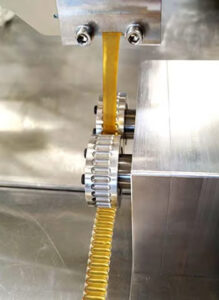
Three-Tec’s twin-screw extruders enable the production of high-precision pharmaceutical implants for controlled, long-term drug release. The complete production system covers every process step, from high-precision gravimetric feeding of raw materials, through extrusion and controlled drawing with integrated diameter control, to the final trimming of the implants. This flexible process makes it possible to precisely tailor the shape, size, and drug load of each implant to specific therapeutic requirements. Through the use of biodegradable polymers, the implants are safely absorbed by the body after they have fulfilled their function. The technology is particularly well-suited for advanced applications such as targeted cancer therapies, effective pain management, and long-acting contraception.
Wet granulation
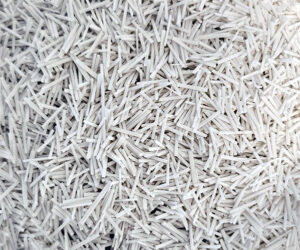
Twin-screw extruders are particularly well-suited for wet granulation because they combine mixing, wetting, and granulation in a single continuous process step. The intermeshing screws ensure that the powder is very evenly wetted with the granulation liquid, resulting in high process stability and reproducible granule properties. The modular screw geometry also makes it possible to specifically tailor shear, mixing intensity, and residence time to the respective formulation.
Compared to traditional batch processes, such as those using a high-shear mixer, continuous twin-screw granulation offers significantly better process control, fewer batch-to-batch variations, and easier scaling from the laboratory to the production scale. In addition, fewer raw materials are required for development trials, since only small quantities of material need to be processed and process parameters can be adjusted quickly.
Additional advantages include the compact design, easy integration into continuous production lines, and the ability to precisely adjust the granule size and properties. This results in granules with a homogeneous distribution of active ingredients, good flowability, and high product quality.
Food
Spraying
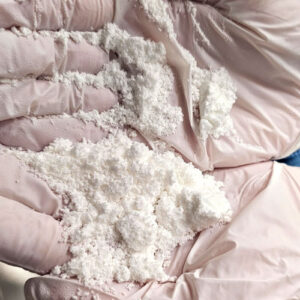
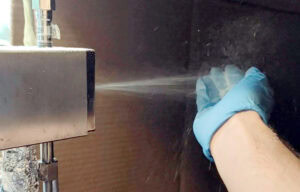
Innovative functional ingredients can be produced efficiently using extrusion. Selected powdered and liquid ingredients are metered directly into the barrel and then melted. This eliminates the need for preliminary premixing of the ingredients. Using an appropriate screw configuration, a homogeneous mixture and controlled pressure buildup are created upstream of the appropriate die, enabling the production of a powdered extrudate via a spray process. This technology enables the production of customized products in a single process step, making them ideal for the food industry, dietary supplements, and functional products.
Expanded Snacks
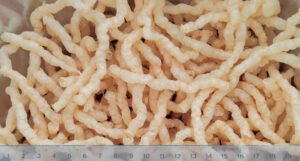
Extrusion allows for the efficient production of innovative snack products in a wide variety of shapes and with different flavor profiles. Co-rotating twin-screw extruders enable intensive mixing processes directly within the extruder, eliminating the need for separate premixing of raw materials—a clear advantage over traditional single-screw extruders. The process allows for precise control of shape, porosity, and nutrient content, as well as flexible processing of a wide variety of raw materials. It is ideal for modern applications such as high-protein snacks, gluten-free alternatives, or high-fiber nutritional solutions.
Meat substitutes
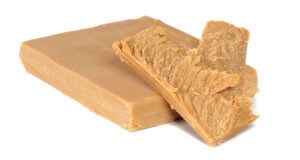
Meat substitutes are generally more environmentally friendly than conventional meat and consume significantly fewer resources in production. With the trend towards more conscious meat consumption or complete renunciation, the demand for meat substitute products is also increasing. Extruders play an important role in the production of individual meat substitute products. Processing in an extruder gives vegetable proteins such as pea, soy, wheat proteins, etc. the desired meat-like texture.
Three-Tec’s twin-screw (co-rotating) extruders enable the production of end products that meet the growing demands of customers and the industry. Using the company’s proprietary flat-tray feeders, even powders with very poor flowability can be precisely fed, which forms the basis for a stable extrusion process. The protein-containing product is then mixed with water, kneaded, cooked, and expanded into textured vegetable protein (TVP), or—as a meat substitute with a high water content (HMMA)—textured using a cooling nozzle and shaped into the desired form.
Chemistry
Mechanochemistry / Green Chemistry / Reactive Extrusion
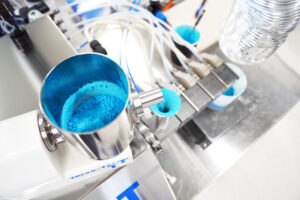
Twin-screw extruders are ideally suited for the research and development of mechanochemical processes (reactive extrusion) because they precisely combine mechanical energy, shear forces, temperature, pressure, and mass transfer in a continuous process. Thanks to the modular design of the screws, process parameters such as residence time, mixing intensity, shear stress, and conveying behavior can be specifically adapted to the respective reaction or formulation. Compared to traditional batch processes (e.g., ball mills or stirred reactors), they enable significantly better process control and reproducibility.
Another advantage is the continuous operation, which allows for easy transfer from the laboratory to the pilot and production scales, thereby reducing scale-up risks. In addition, solids, liquids, and additives can be dosed at different points, enabling complex reaction pathways. Of particular interest in mechanochemistry is the fact that chemical reactions can often be carried out with little or no solvent, thereby reducing costs, waste volumes, and environmental impact.
Lignin Extraction
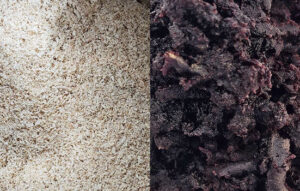
Twin-screw extruders are ideal for lignin extraction because their intermeshing screws generate very high mixing and shear forces, which effectively break down the lignocellulosic structure. This breaks down cell walls, increases the material’s surface area, and allows solvents to penetrate the biomass much more effectively. Another advantage is the precise control of residence time, temperature, and shear stress, enabling the extraction process to be optimally tailored to the specific material. In addition, twin-screw extruders enable continuous process operation, which offers high productivity and good scalability compared to batch processes. Studies show that extraction using twin-screw extrusion can significantly improve lignin yield and biomass digestion.
Battery production
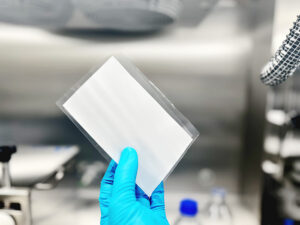
Extrusion can be used to efficiently produce electrode materials for both conventional batteries and innovative polymer batteries. In electrode production, active materials such as graphite or lithium compounds are mixed with binders and conductive materials and then extruded to create anodes and cathodes. At the same time, the extrusion process also enables the production of polymer electrolytes for polymer batteries, such as those used in modern solid-state or polymer electrolyte batteries. Through precise control of temperature and mixing ratios, the raw materials are processed into homogeneous materials that offer both high ionic conductivity and excellent structural integrity. These technologies provide a scalable solution for the production of high-performance, safe, and long-lasting energy storage devices for a wide range of applications.
Plastics
3D Printing
Three-Tec's twin-screw extruders can be integrated directly into modified FFF (Fused Filament Fabrication) 3D printers, where they handle the feeding, heating, and precise extrusion of the respective material.
Three-Tec extruders play a key role, particularly in the AME (Additive Manufacturing of Elastomers) process. Due to the high viscosity of rubber compounds, processing using conventional filament print heads would not be possible. Thanks to the comparatively very high torques of the Three-Tec extruders, the necessary discharge force can be provided. In addition, the extrusion system can be easily integrated into the control system of a 3D printer via software. Thanks to several independently controllable heating zones, the elastomer compounds can be processed at defined temperatures.
In a specific application, a Three-Tec extruder was used for the additive manufacturing of carbon black-filled rubber compounds. The system alternately prints uncured rubber layers and a thermoplastic support structure, which stabilizes the shape of the part until the subsequent vulcanization. After printing, the carbon black-filled elastomer parts are vulcanized in an autoclave.
Special Applications
Electrospinning
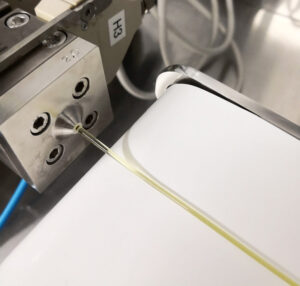
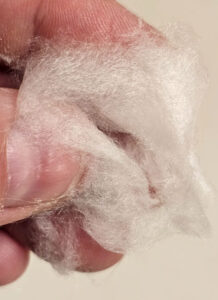
Three-Tec combines high-precision extrusion with electrospinning technology to transform thermoplastic polymers into high-quality microfibers and engineered fiber structures. During extrusion, the polymer is melted and homogenized under controlled temperature and shear conditions, ensuring reproducible production with exceptional precision and consistency. Our extrusion systems also enable the production of customized polymer blends and formulations, which can then be dissolved, diluted, and processed into electrospinning solutions. This allows for precise control of material properties from the raw material all the way to the finished fiber structure.
Roasting and Blending
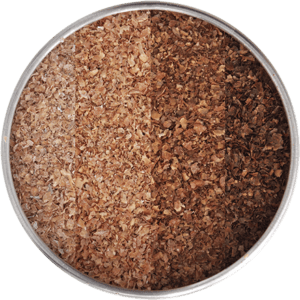
Specially adapted screw configurations, featuring screw elements developed specifically for this purpose, enable the roasting of whole grains without crushing the individual grains.
Another exceptional process is the continuous mixing of solids in the extruder barrel. In this process, multiple raw materials are metered into the barrel and gently mixed. This continuous process can take place in a heated downstream extruder barrel prior to further processing. As a result, no processing time is lost in the main barrel.
Ultra-hard materials
Processing hard particles in a melt can cause severe abrasion on screw elements and the barrel. To minimize this wear and prevent metallic abrasion, screw elements and barrel bores are coated with tungsten carbide. Tungsten carbide is characterized by its extreme hardness and wear resistance, which reduces abrasion caused by abrasive particles. This coating extends the machine’s service life. At the same time, product quality is ensured, as no abrasion particles enter the final product. This is an effective solution, particularly when processing abrasive materials in the plastics, pharmaceutical, and food industries, as well as materials used in battery manufacturing.
Contact
Are you interested in our equipment, do you have questions about it, or would you like a personalized consultation?