
Newsletter 12/2025
Extruders in mechanochemistry – an insight
The waste problem in the chemical industry requires new, environmentally friendly solutions. The combination of mechanochemistry with continuous extrusion represents a promising approach.
The increasing problems with waste disposal in the chemical industry call for sustainable solutions. One particularly promising strategy is mechanochemistry, a process that has proven effective in a wide range of chemical applications. Mechanochemical reactions are environmentally friendly, as they often do not require solvents, achieve high yields, and enable short reaction times. Currently, mechanical energy is mostly supplied by ball milling, which is an established process but is limited to small production volumes. Scaling up to industrial levels has been a challenge so far. To overcome this bottleneck, continuous reactive extrusion is increasingly coming into focus. It offers the potential to transfer mechanochemical processes into industrial practice in an efficient, continuous, and resource-saving manner.
Viviene Chantrain is conducting research on this topic as part of Prof. Dr. Borchardt's team at Ruhr University in Bochum: «We are convinced that mechanochemistry will make an important contribution to the further development of the chemical industry toward the sustainable use of resources and energy. However, since the production capacities of most ball mills are limited for safety reasons, the extruder offers an easily scalable and continuous method.»
Using a Three-Tec ZE 12 extruder with an L/D ratio of 40:1, Viviene Chantrain and her team developed the first direct mechanocatalytic reaction protocol for the Suzuki-Miyaura reaction* in an extruder. By coating the screws or cylinder of the extruder with a thin layer of palladium, they were able to carry out cross-coupling reactions continuously, without solvents and without the addition of molecular or powdered catalysts.
The study highlights the delicate interplay of key process parameters such as temperature, mechanical energy input, residence time, rheology, and catalyst contact time. Targeted optimization of these parameters resulted in product yields of 36% % and 75% %, respectively, with longer reaction times. The extruder and the support provided by Three-Tec impressed Viviene Chantrain in her work: «For me, the Three-Tec extruder stands out in particular for its user-friendly and flexible design, as this allows us to use many different synthesis methods or run cascade reactions. When using it, you can clearly see how well thought-out the design of the extruder is, especially in the details. Three-Tec was always helpful when we had problems or questions. Even with our unusual special parts and very specific problems, we were always taken seriously and given competent and friendly advice.»
The results of the research make a significant contribution to the further development of mechanocatalysis into a continuous, scalable, and industrially viable process. Looking to the future, the aim is to make mechanochemistry more attractive for industrial production. In particular, this will be achieved through further ball mill protocols that are adapted for the extruder based on the trends shown (e.g., amide bond formation, Buchwald-Hartwig coupling, Dakin reaction, Michael addition, Heck reaction, or Friedel–Crafts reaction). At the same time, geometric scale-up to larger extruders/screws for the required reaction mixtures and their sometimes unfavorable rheology, as well as the exact influences of the various kneading elements and their number, should also be further investigated.
Here You can find the complete paper «Continuous Direct Mechanocatalytic Suzuki-Miyaura Coupling via Twin-Screw Extrusion.».
Viviene Chantrain wrote her master's thesis on «Mechanochemical synthesis by extrusion.» She is currently a doctoral student at Ruhr University in Bochum, where she continues to conduct research on «Scalability and sustainability of mechanochemical processes.».

* The Suzuki-Miyaura reaction is a chemical reaction that allows two organic molecules to be linked together by a C-C bond. The reaction connects a molecule containing a boron atom to another molecule containing a halogen atom such as bromine or iodine. A palladium catalyst is necessary for this coupling to proceed efficiently. It accelerates the reaction and enables the connection under mild conditions. In addition, a base is added, which is necessary for the catalysis cycle. The result is a new, often more complex molecule in which two carbon groups are directly linked to each other. The Suzuki-Miyaura reaction is one of the most important methods in modern organic chemistry due to its reliability and versatility. It is frequently used in pharmaceutical research, in the manufacture of active ingredients, and in materials science.
Precise feeding in the milligram range
In a recent series of tests, the feeding performance of our devices was examined for very small target quantities. The goal was batch feeding of 60 mg of powder with a permissible tolerance of ±3 % for a future project.
The aim of the tests was to achieve a batch weight of 60 mg (0.06 g) with a maximum deviation of ± 1.8 mg. The aim was to test the technical feasibility and process reliability for this small quantity for a future customer project. A fine-grained semolina with a grain size of less than 300 µm, which is comparable to the customer's original product, was used for the tests.
We used the smallest feeding device in our portfolio, a ZD 5 FB flat-tray feeding device, which continuously weighed the discharged quantity using a high-resolution load cell and adjusted the screw speed accordingly. The tests were carried out in our test laboratory under stable environmental conditions in order to minimize external influences.
The tests were successfully completed: the feeding values achieved were within the tolerance range of ±1.8 mg. This confirmed that the device also works precisely and repeatably in the low milligram range. The measurement results also showed that fine adjustment of the parameters can achieve stable feeding performance across multiple batches. Fluctuations in material flow or bulk density had only a minor effect on the result.

Measurement results of the tests (weight/time)
Three of the high-precision feeding devices will be integrated into a customer's production line in the future. These devices complement the process by adding a small amount of powder to pre-filled containers. The integration is both mechanical and control-related. The devices can communicate directly with the plant control system via standardized interfaces. This allows the feeding process to be carried out automatically and reproducibly. The compact design of the devices allows for easy integration into existing plant structures.
Further information about our feeding devices can be found here.

60 mg fed material

ZD 5 FB flat-tray feeding device
Current Projects
Many of our devices are developed and produced according to the specific requirements of our customers. We show you some of the devices and machinery that were completed and delivered in recent months.
Extruder for the production of meat substitute products and puffed snack products


Devices:
ZE 12 HMI extruder, ZD 12 B gravimetric feeding device, liquid dosing pump
Industry/Use:
Research. Production of meat substitutes and puffed snack products
Special feature:
- Modular cooling nozzle
- Production of HMMA (High Moisture Meat Analogues) and TVP (Texturized Vegetable Protein)
Extruder with split barrel with recirculation channel

Devices:
ZE 5 HMI extruder, split barrel with recirculation channel
Industry/Use:
Research and development. Depolymerization of plastics
Special feature:
The barrel is equipped with a return channel. This allows the material to be fed back to the screw after an extrusion process, and the process can be repeated as often as desired. This improves the homogenization of the melt, for example in the case of components that are difficult to melt or products that are difficult to mix. Once the desired degree of processing has been achieved, the operator can flip the lever and the material is extruded through the replaceable nozzle opening. With our solution, the barrel can be operated normally with a standard nozzle. In contrast to other systems, there is therefore no impairment due to complex outlet geometries when extrusion without recirculation is to be performed. The extrudate then does not have to be diverted or passed through the switch valve, which significantly improves extrudability and cleanability. This allows for more options without the disadvantages of an extrusion process without recirculation.
Extruder for research and development of chemical reactions

Devices:
ZE 12 HMI extruder on trolley for use in a vertical fume hood, split barrel can be operated with or without counter bearing, ZD 9 FB flat-tray feeding device, gravimetric, micro gear pump, heatable, thermostat for deep-freezing the barrel in the final zones
Industry/Use:
Research and development of chemical reactions, polymer production, melt granulation, powderization in the barrel
Special feature:
The material is melted and then rapidly cooled again in the final barrel zones to allow it to solidify and be pulverized. The entire system is mounted on a table (special frame) so that it can be rolled into a fume hood.
Extrusion line for melt and wet extrusion


Devices:
ZE 18 HMI extruder, two ZD 12 FB flat-tray feeding devices, gravimetric, hygienic design, side feeding device, cooling conveyor belt, granulator, hot discharge
Industry/Use:
Pharmaceuticals. The extrusion line is used for both melt and wet extrusion/granulation.
Special feature:
- GMP facility with complete documentation
- Innovative pulse cooling system for extruder barrels for precise temperature control
- Maximum flexibility for process development
Laboratory extruder with newly developed hot cutter

Devices:
ZE 12 HMI extruder, ZD 12 side feeding device, hot cutter, micro gear pump
Industry/Use:
Chemistry. Development of solutions for CO₂ reduction in industry
Special feature:
- Newly developed, powerful hot cutter with three-edged rotary blade and more powerful motor
- Side feeder for the forced feeding of dry components that are difficult to flow and have a tendency to clump.
The complete production line from a single source
Our product range includes a wide selection of process equipment that can be used to implement complete production lines.
In addition to our main equipment, extruders and feeding devices, we also offer a wide range of additional equipment. When planning a complete production line, we take care of the development, manufacture, integration, and coordination of all components. This means you have a single point of contact with clear responsibilities and a system that is designed as a single unit from the outset. If necessary, we also integrate third-party equipment to ensure seamless integration. From the initial idea to commissioning, we remain the sole point of contact for our customers.
All our devices are manufactured at our site in Seon. This allows us to maintain control over every step of the process: from the raw materials to processing and the finished device. This guarantees short distances, fast response times, and the highest quality.
The process equipment in our portfolio:


Granulator HMI
The Granulator HMI can be used to process strands into granulate. The granulate size can be adjusted between 0.5 and 15 mm during the processing process.

Conveyor belt laboratory
The conveyor belt is suitable for gentle removal and cooling of the extrudate at temperatures of up to 300 °C.

Film roller
The film roller enables flat extrudates to be calibrated. In addition, round extrudates can be rolled out into a film and wound evenly onto a spool.
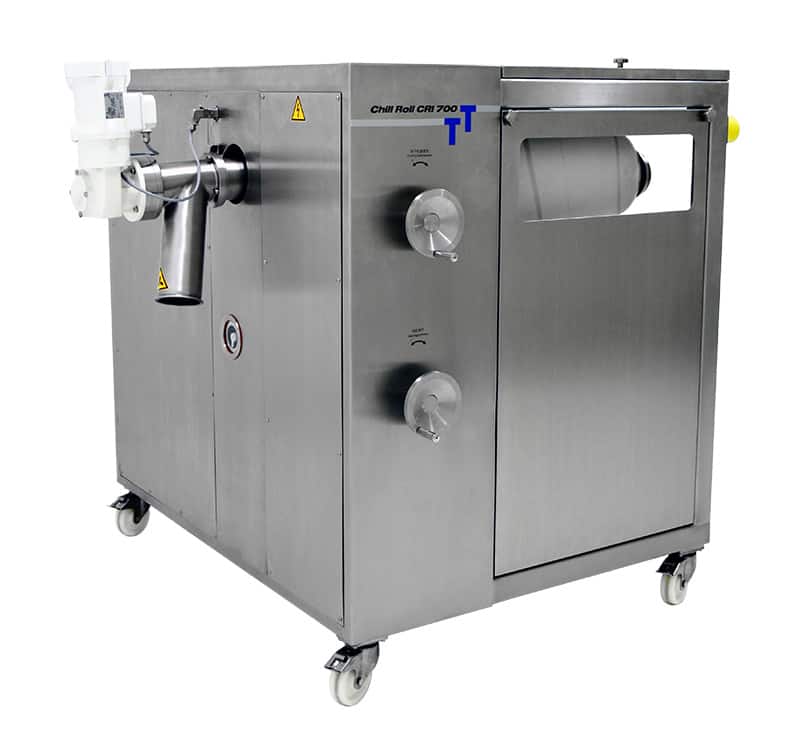
Chill Roll
The cooling roller is suitable for the efficient and continuous cooling and comminution of extrudates from approx. 3 kg/h to approx. 100 kg/h.
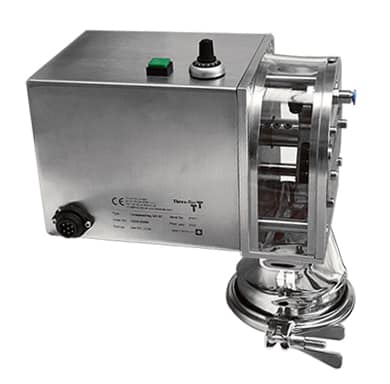
Hot cutter
With the hot cut, the extrudate can be processed into granules ranging in size from 0.5 to 10 mm using one or more knives attached directly to the die plate.

Cooling conveyor belt
The cooling conveyor belt allows extrudates and granulates to be cooled efficiently and transported away gently.
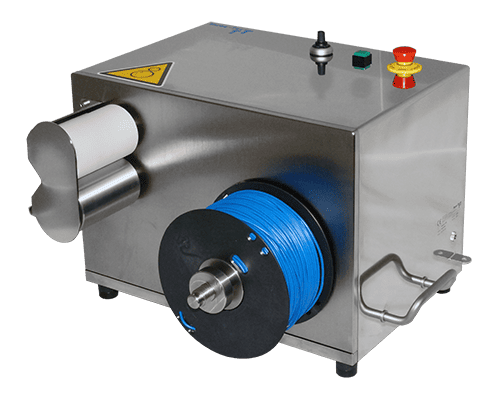
Rewinder
The winder is suitable for winding the extrudate onto a spool. The tensile force between the pull-off roller and the spool is adjustable, which enables very even winding.
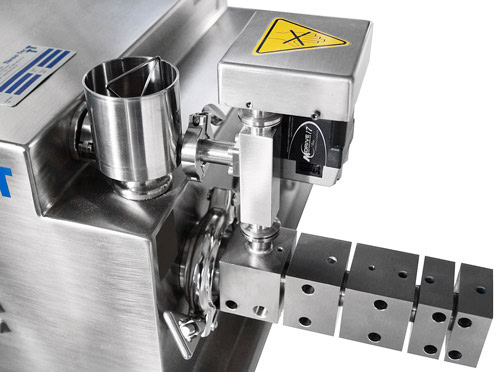
Stuffing feeding device
The stuffing feeding device is used for the reliable feeding of products that are very difficult to dose or very cohesive and very light into an extruder.
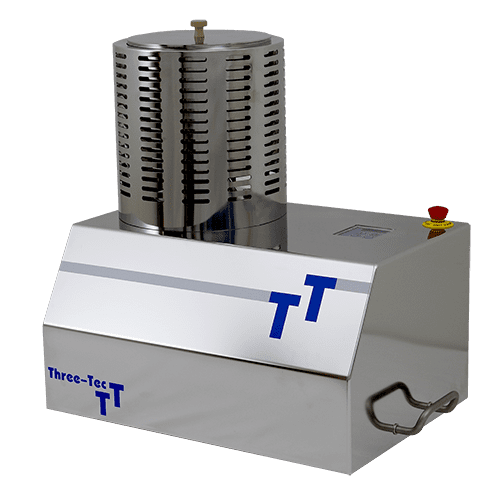
Spheronizer
The Spheronizer is used to reduce the length and round off fine extrudate strands. Depending on the container size, batch quantities of 5 to 2,000 g can be processed.
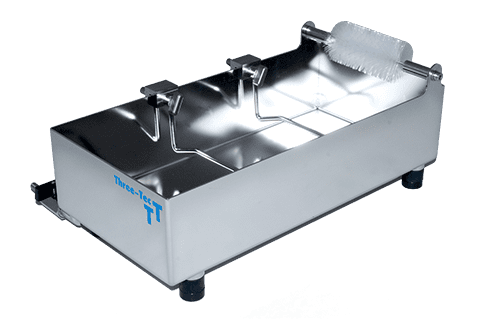
Cooling bath
The cooling bath, available in various lengths and designs, is used for the efficient cooling of various extrudates prior to further processing with a winder or granulator.

Calender
The calender is a versatile laboratory device which, in combination with a hot melt extruder, can be used to continuously produce tablets directly from the still-hot extrudate.
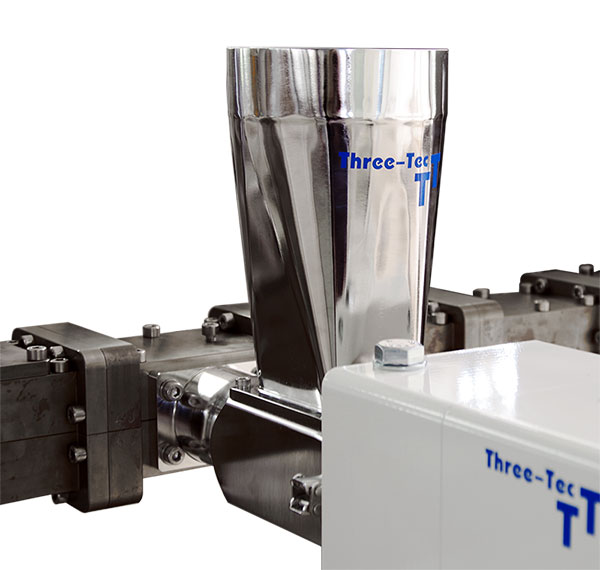
Side feeding device
Powders, granulates, or fibers are fed into an extruder by means of a side feeder.