
Newsletter 05/2026
More tender meat alternatives from the extruder
Using an extruder from Three-Tec, a research team from the University of Massachusetts has shown that the direct introduction of nitrogen gas in the extrusion process can specifically improve the texture of plant-based meat alternatives.
The characteristic textural properties of different types of meat, such as bite, juiciness or fibrousness, are difficult to replicate with plant proteins. High-moisture extrusion is one of the most important technologies for the production of fibrous, anisotropic meat substitutes. However, the process typically produces dense, barely porous extrudates that tend to have a tough texture and make it difficult to absorb flavors and colors. The study by Dr. Lutz Grossmann and his research team at the University of Massachusetts investigated whether a targeted introduction of nitrogen gas directly into the extrusion process can improve the texture.
A ZE 12 co-rotating twin-screw extruder from Three-Tec was used. The starting material was soy protein concentrate (66.1 % protein) with a water content of 65 % in the end product. Nitrogen gas was introduced at volume flows of 0 to 40 ml/min via injection ports specially manufactured by Three-Tec. Two injection positions in the extruder barrel were investigated: the middle area (barrel 3, 100 °C) and the end area (barrel 4, 120 °C).
As the gas volume flow increased, the density of the extrudates fell by up to 14.8 %. The porosity increased in the middle area from 2.1 % to 9.4 %, in the end area even to 15.3 %. Larger and more irregular pores occurred preferentially when injecting in the end area due to the higher temperature. Hardness and chewability decreased significantly with increasing gas flow. At the same time, the extrudates became lighter in color and optically more fibrous. The elastic anisotropy index increased from 1.35 (without gas) to a maximum of 1.70 with a gas flow of 5 ml/min in the middle range.
In combination with targeted nitrogen gas injection, the extruder enables precise control of the texture, porosity and fibrousness of plant-based high-moisture extrudates. The gas volume flow has the strongest influence, while the injection position modulates the pore size and the visual fiber structure. Optimal tenderness is achieved at a gas-to-flow ratio of 0.79 %, while the highest anisotropy is achieved at 0.098 %. By adjusting both parameters, different types of meat can be better imitated. In addition, the increased porosity opens up possibilities for post-processing: porous structures absorb marinades, flavors and colorants more efficiently.
«Table-top extruders are an indispensable tool in research. The customized solutions from Three-Tec offer us the flexibility to work with both novel raw materials and innovative technologies.»
Dr. Lutz Grossmann, Department of Food Science, University of Massachusetts
Here you can find the complete paper «Tailoring anisotropy and tenderness in high-moisture extruded plant protein structures by in-line microfoaming».

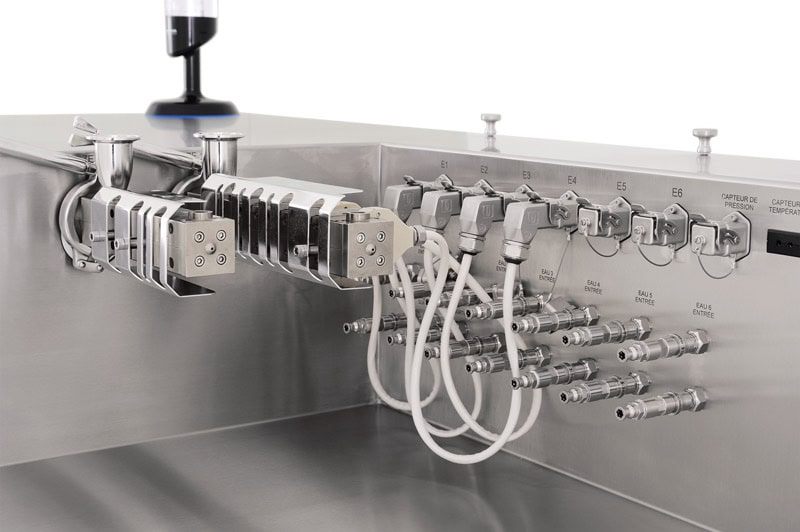
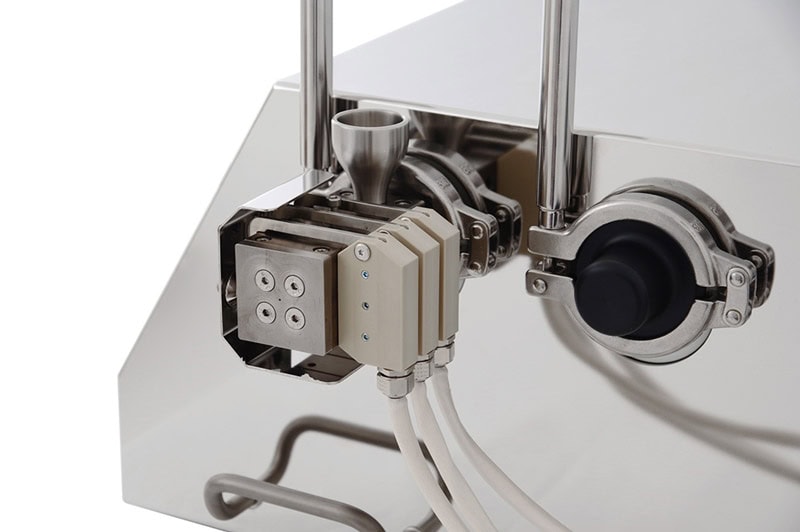
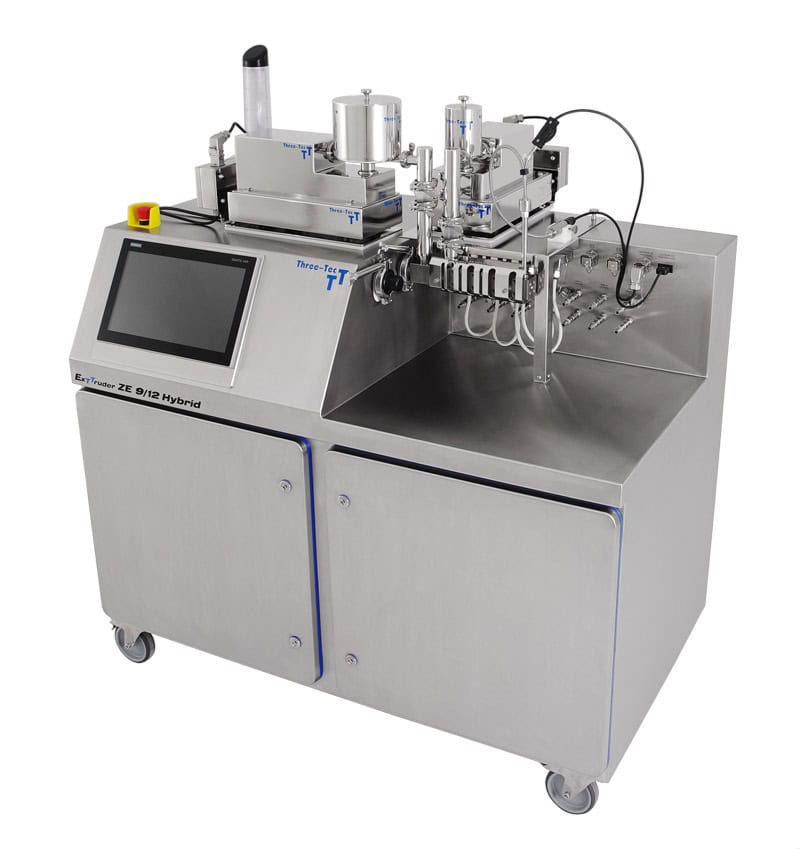
Two screw diameters, one device: The laboratory extruder hybrid
Choosing the right screw diameter is crucial for a laboratory extruder. If you don't want to limit yourself and want to carry out test series with different diameters, the laboratory extruder hybrid is the ideal solution.
In the early phase of formulation development, researchers often only have access to very small and often cost-intensive quantities of active ingredients. At the same time, the development of an optimal formulation requires numerous series of tests. This combination of limited resources and high experimental requirements places particular demands on the process technology used. With the laboratory extruder hybrid, Three-Tec offers a solution that has been specially developed for extrusion processes on a resource-saving miniature scale.
As a combination device, the parallel twin-screw laboratory extruder hybrid offers a choice of two different extruder sizes. Three variations are available, each with a choice of two screw diameters (5, 9 or 12 mm). The variant with a 5 mm screw diameter and an L/D ratio of 15:1 in particular drastically reduces the consumption of active ingredients or target materials thanks to an extremely small empty volume of just 1.2 cm³. Very small batches can be produced from as little as 1 gram. As only very small residual quantities remain in our laboratory extruders, a high yield of the materials used is achieved. With an initial quantity of one gram, for example, an extrusion quantity of 0.7 to 0.8 g is realistic. The results provide a reliable basis for reproducible scaling up to larger production scales.
A key feature of the laboratory extruder hybrid is its high degree of flexibility. Thanks to the universal use of heating cartridges, cooling systems, die plates and pressure and temperature sensors, the extruder can be converted from a 5 mm to a 9 mm or 12 mm screw diameter in just a few minutes. This significantly extends the range of applications compared to conventional laboratory extruders. The modular design of the screws with conveying, return, mixing and kneading segments - even in our smallest extruder - allows precise adaptation to a wide range of extrusion processes.
With the laboratory extruder hybrid, Three-Tec combines resource-saving work, high flexibility and precise process control. For research teams working with small and valuable quantities of material, this technology opens up new possibilities for developing formulations faster and more economically.


Current Projects
Many of our devices are developed and produced according to the specific requirements of our customers. We show you some of the devices and machinery that were completed and delivered in recent months.
Extruder system with laser measuring head


Devices:
ZE 9 HMI extruder, ZD 5 FB gravimetric flat-tray feeder, cooling conveyor belt, laser measuring head from a third-party supplier
Industry/Use:
Research in the Medical and Pharmaceutical Sectors Using 3D Printing
Special feature:
The 2-axis laser measuring head is used to measure the extrudate either at the end of the process for documentation purposes or between the outlet at the die and the haul-off belt. If the measurement is taken between the die and the take-off belt, the take-off speed can be controlled to ensure a consistently uniform diameter.
Extruder as an addition to an existing system


Devices:
ZE 12 HMI extruder, two-part barrel, micro pressure sensors and insulation sleeve for the heating zones, special sensor box for the pressure sensors
Industry/Use:
Applications in the field of mechanochemistry
Special feature:
The ZE 12 extruder supplements an existing ZE 9 extruder that is already integrated in the laboratory production line.
As the fed material has an extremely low viscosity, an inlet valve on the barrel replaces the conventional feed hopper. The screw elements were specially designed at the customer's request to ensure a zero clearance between the conveying and kneading elements. Microsensors on the barrel measure temperature and pressure and are read out via a separate sensor box. The barrel is also insulated to minimize energy consumption due to heat loss.
Feeding device for filling bridging powder

Devices:
ZE 9 FB gravimetric flat-tray feeding unit
Industry/Use:
Precise filling of fine, bridge-forming powder
Special feature:
The customer visited our in-house laboratory before placing the order and, after a long search, found the right solution with us. Automatic and high-precision batch feeding is triggered at the touch of a button. This replaces a very complex and time-consuming manual filling process using a precision scale.
Extruder with recirculation channel


Devices:
ZE 5 HMI extruder with recirculation channel in the barrel, ZD 5 FB i6000 flat-tray feeder with integrated load cells
Industry/Use:
Biotechnology
Special feature:
The barrel has been equipped with a recirculation channel. Thanks to this, the material can be fed back to the screw after an extrusion process and the process can be repeated as often as required until the desired degree of processing has been achieved. The valve at the outlet can then be switched over and extruded through a standard nozzle.
Custom-made tray scraper


Devices:
Custom-made tray scraper for an existing ZD 5 FB flat-tray feeding unit, which is operated with a ZE 5/12 laboratory extruder hybrid.
Industry/Use:
University research
Special feature:
The design of the tray scraper was developed in collaboration with the customer. It improves the flow of the product, which is difficult to dose, into the screw channel.
Trade fair participation 2026: Experience our devices in action
This year, we will once again be represented at selected trade fairs and present our devices in direct contact with interested trade visitors.
We take part in various trade fairs throughout the year. We take the opportunity to show our devices in practical use and talk to users. Our experts on site answer questions, provide insights into current developments and demonstrate practical applications.
We will be represented at the following events this year:

PPS-41: 41st International Conference of the Polymer Processing Society
May 31 to June 4, 2026, Paestum (Salerno), Italy
The conference brings together academics, researchers and industry representatives to discuss current and future developments in polymer processing.

30th Fakuma
October 12 to 16, 2026, Friedrichshafen, Germany
Fakuma is regarded as an important meeting place for the plastics processing industry, particularly in the areas of injection molding, extrusion and thermoforming.
Visit us in Hall A6, Stand 6417.

LAB-SUPPLY Freiburg
October 21, 2026, Freiburg, Germany
The regional trade fair offers an overview of instrumental analysis, laboratory technology, laboratory chemicals and life science.

AAPS PharmSci 360
October 25 to 28, 2026, New Orleans, USA
The event brings together international experts from pharmaceutical research and development. Our devices will be presented by our sales partner Xceptional Instruments.
You can find more information here. We look forward to meeting familiar and new contacts at the trade fairs.